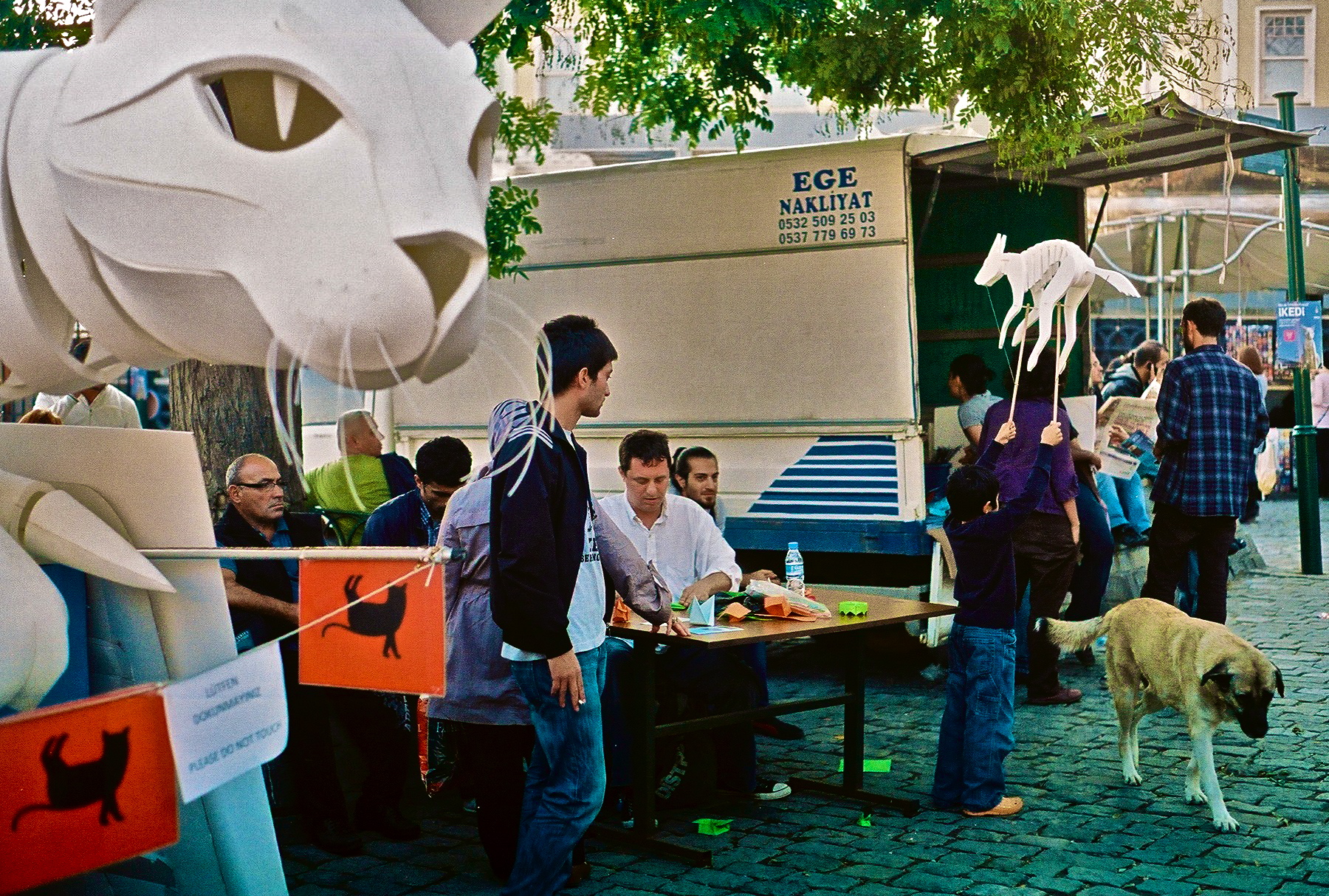
Foam-rubber animals filled Ortekay Square in Istanbul, Turkey last year, in a public art project inspired by the feral dogs & cats, gulls, & dolphins who share the city.
Last night I felt I had begun to understand the nascent, boundary-straining field of zooethnography. Having traveled to Sweden’s old university town of Uppsala for a conference on it four days earlier, I met separately with organizer Jacob Bull and presenting scholar Eva Hayward, to help answer some lingering questions.
Both of them are members of the “HumAnimal” group at Uppsala University’s Center for Gender Research–a group which over the past year has embraced the term and field of zooethnography, and begun to define its challenges.
Zooethnography, Hayward explained, is the study of how animals shape human-animal encounters. Like traditional ethnographers, who study human cultures, zooethnographers study these encounters in light of the cultural environments in which they occur–like a particular research lab, city park, or farm.
On Monday Hayward presented one such study, Migrations of Light: Whale songs and Photographs, in which she proposed an understanding of how humpback whales affected a group of human researchers in Maine, through photographs of the whale’s flukes.
In sense-soaked language that barely felt like prose, she explained how the whales impressed their movement, weight, texture, ebullience, sociality, and even their songs into the senses of the researchers, through the physical medium of archived photographs.
Zooethnographic research does not assume that animals are intentionally manipulating our relationships (though cat guardians might be willing to go that far), but simply that they are active participants–not passive instruments–in their interactions with humans. And as active participants, their bodies, movements, feelings, and ways of understanding the world all help to co-create the “more-than-human” cultures they live in with us.
Imagine how different the culture might be of a cat park, compared to a dog park, even if the same group of humans were at its sidelines. (…Google reveals that an abundance of satire journalists have already tried to imagine such a culture.)
Few of us would question the idea that animals affect us. Our companion animals change the form and content of our lives in every way, provoking comfort, frustration, smells, new ideas, and walks down the street. The darting motions of mice or spiders elicit terror in some people. And the experience of eating meat is influenced by the physiological, hormonal, and social experiences of the animal who became that meat.
But, just as human laws have been slow to refine the legal status of animals as property (more on that next week!), research methods have likewise been slow to include animals’ direct contributions to culture.
Species differences in communication make it no small feat to understand how multispecies cultures should be studied, and Bull is careful to say that HumAnimal is not presenting zooethnography as a new methodology, but as an invitation:
“To take what Derrida refers to as The Animal Question, to methodology. To say that if we’re going to take other animals seriously, then we must also question how we are taking them seriously, and what are the significances and impacts of speaking for them, speaking with them, speaking nearby to animals.”
The HumAnimal group is currently working on a kind of declaration for zooethnography which addresses, among other problems, the need to handle constructively the twin human habits of anthropocentrism (viewing the world through a human-centered lens) and anthropomorphism (attributing seemingly “human” characteristics to non-humans).
Visit this page on their web site, to follow the continued unfolding of this group’s questions and research.
 Sentient Cincinnati
Wonderful piece. Thank you for representing these nascent efforts with such enthusiasm and imagination.